SDK setup, payloads, endpoints, and user data flow.
A-TRACK documentation for browser, SSR, backend, and analytics ingestion workflows. Start with init, attach attributes, track events, and query sessions back through the API.
On This Page
Overview
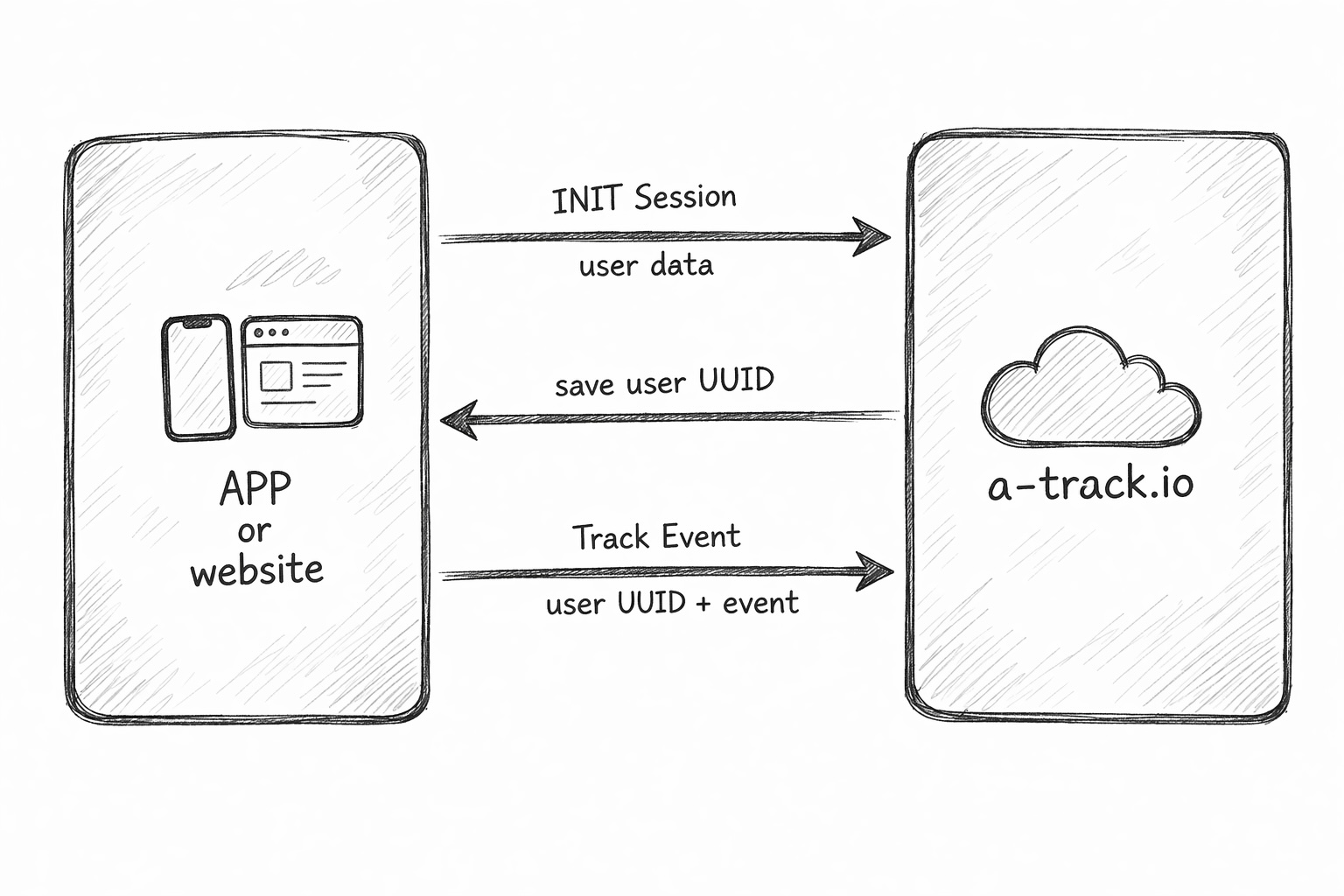
A-TRACK helps you create a session identity, ingest client and server context, attach attributes, track events, enrich the session with attribution and device data, and read the final structured profile back through API endpoints.
Public Key Auth
Send the SDK public key in the x-a-track-key header. Backend project routing and DB selection are resolved from that key.
UUID Flow
If no UUID is passed during init, the SDK can generate one, persist it locally, and reuse it for all future events and attribute updates.
Quick Start
- Initialize the SDK with your public key and optional known UUID.
- Send optional user and client context during init.
- Call
setAttributesany time you want to attach or overwrite profile properties. - Call
trackwith an event name, event attributes, and optionally a known UUID override. - Read back the enriched session through
session/showor query events withevent/show.
Official SDKs
Use the official A-TRACK SDK for your stack, or call the raw HTTP API directly if you want full control.
| SDK | Use Case | Repository |
|---|---|---|
| Frontend SDK Browser, Vue, Nuxt, Next, Angular, plain JS |
frontend |
github.com/a-track-io/frontend-sdk |
| Node.js SDK SSR, backend services, server-side event delivery |
nodejs |
github.com/a-track-io/nodejs-sdk |
| Python SDK Backend apps, workers, data pipelines |
python |
github.com/a-track-io/python-sdk |
| Go SDK High-performance backend services |
golang |
github.com/a-track-io/golang-sdk |
| Rust SDK Low-level services and high-throughput ingestion |
rust |
github.com/a-track-io/rust-sdk |
| PHP SDK PHP apps and Laravel-style backends |
php |
github.com/a-track-io/php-sdk |
| Swift SDK Native Apple platform integrations |
swift |
github.com/a-track-io/swift-sdk |
| .NET SDK C# applications and .NET services |
dotnet |
github.com/a-track-io/dotnet-sdk |
| Perl SDK Legacy systems and Perl service integrations |
perl |
github.com/a-track-io/perl-sdk |
| Raw API Direct HTTP integration without an SDK |
api |
Use the examples below on this page |
Real-Life Examples
A common flow looks like this: a new user lands on your page from an ad click, the SDK initializes without a known UUID, your app reads the generated UUID, and later another part of your system tracks an event with that UUID explicitly.
Init without UUID, but with source URL and ad click context
Send the landing URL, UTM tags, and click IDs. A-TRACK creates the session UUID for you.
POST /init
x-a-track-key: your_public_key
content-type: application/json

{
  "context": {
    "url": {
      "href": "https://a-track.io/pricing?utm_source=google&utm_campaign=spring-launch&campaign_id=cmp_123&gclid=gclid_123&fbclid=fbclid_123",
      "raw": "/pricing?utm_source=google&utm_campaign=spring-launch&campaign_id=cmp_123&gclid=gclid_123&fbclid=fbclid_123",
      "path": "/pricing",
      "query": "?utm_source=google&utm_campaign=spring-launch&campaign_id=cmp_123&gclid=gclid_123&fbclid=fbclid_123",
      "source_url": "https://partner.example.com/blog/first-touch",
      "referer": "https://google.com/"
    },
    "client": {
      "ipAddress": "50.89.98.90",
      "userAgent": "Mozilla/5.0 (iPhone; CPU iPhone OS 17_2_1 like Mac OS X)",
      "locale": "en-US",
      "timezone": "America/New_York"
    }
  }
}const sdk = createATrackSdk({
publicKey: "your_public_key"
});
await sdk.init({
context: {
url: {
href: "https://a-track.io/pricing?utm_source=google&utm_campaign=spring-launch&campaign_id=cmp_123&gclid=gclid_123&fbclid=fbclid_123",
raw: "/pricing?utm_source=google&utm_campaign=spring-launch&campaign_id=cmp_123&gclid=gclid_123&fbclid=fbclid_123",
source_url: "https://partner.example.com/blog/first-touch",
referer: document.referrer
}
}
});const sdk = createATrackNodeSdk({
publicKey: "your_public_key"
});
await sdk.init({
context: {
url: {
href: "https://a-track.io" + req.url,
raw: req.url,
source_url: "https://partner.example.com/blog/first-touch",
referer: req.headers.referer
},
client: {
ipAddress: req.ip,
userAgent: req.headers["user-agent"]
}
}
});sdk = ATrackClient(public_key="your_public_key")
sdk.init({
"context": {
"url": {
"href": "https://a-track.io/pricing?utm_source=google&utm_campaign=spring-launch&campaign_id=cmp_123&gclid=gclid_123&fbclid=fbclid_123",
"raw": "/pricing?utm_source=google&utm_campaign=spring-launch&campaign_id=cmp_123&gclid=gclid_123&fbclid=fbclid_123",
"source_url": "https://partner.example.com/blog/first-touch",
"referer": "https://google.com/",
}
}
})sdk := atrack.New(atrack.Options{
PublicKey: "your_public_key",
})
_, err := sdk.Init(&atrack.InitPayload{
Context: &atrack.Context{
URL: &atrack.URLContext{
Href: "https://a-track.io/pricing?utm_source=google&utm_campaign=spring-launch&campaign_id=cmp_123&gclid=gclid_123&fbclid=fbclid_123",
Raw: "/pricing?utm_source=google&utm_campaign=spring-launch&campaign_id=cmp_123&gclid=gclid_123&fbclid=fbclid_123",
SourceURL: "https://partner.example.com/blog/first-touch",
},
},
})let client = ATrackClient::new("your_public_key")?;
client.init(InitPayload {
context: Some(Context {
url: Some(UrlContext {
href: Some("https://a-track.io/pricing?utm_source=google&utm_campaign=spring-launch&campaign_id=cmp_123&gclid=gclid_123&fbclid=fbclid_123".to_string()),
raw: Some("/pricing?utm_source=google&utm_campaign=spring-launch&campaign_id=cmp_123&gclid=gclid_123&fbclid=fbclid_123".to_string()),
source_url: Some("https://partner.example.com/blog/first-touch".to_string()),
..Default::default()
}),
..Default::default()
}),
..Default::default()
}).await?;$sdk = new ATrackClient([
'publicKey' => 'your_public_key',
]);
$sdk->init([
'context' => [
'url' => [
'href' => 'https://a-track.io/pricing?utm_source=google&utm_campaign=spring-launch&campaign_id=cmp_123&gclid=gclid_123&fbclid=fbclid_123',
'raw' => '/pricing?utm_source=google&utm_campaign=spring-launch&campaign_id=cmp_123&gclid=gclid_123&fbclid=fbclid_123',
'source_url' => 'https://partner.example.com/blog/first-touch',
],
],
]);let sdk = ATrackSDK(publicKey: "your_public_key")
try await sdk.init(.init(
context: .init(
url: .init(
href: "https://a-track.io/pricing?utm_source=google&utm_campaign=spring-launch&campaign_id=cmp_123&gclid=gclid_123&fbclid=fbclid_123",
raw: "/pricing?utm_source=google&utm_campaign=spring-launch&campaign_id=cmp_123&gclid=gclid_123&fbclid=fbclid_123",
sourceUrl: "https://partner.example.com/blog/first-touch"
)
)
))var sdk = new ATrackSdk(new ATrackOptions
{
PublicKey = "your_public_key"
});
await sdk.InitAsync(new InitPayload
{
Context = new RequestContext
{
Url = new UrlContext
{
Href = "https://a-track.io/pricing?utm_source=google&utm_campaign=spring-launch&campaign_id=cmp_123&gclid=gclid_123&fbclid=fbclid_123",
Raw = "/pricing?utm_source=google&utm_campaign=spring-launch&campaign_id=cmp_123&gclid=gclid_123&fbclid=fbclid_123",
SourceUrl = "https://partner.example.com/blog/first-touch"
}
}
});my $sdk = ATrack::Client->new(
public_key => 'your_public_key'
);
$sdk->init({
context => {
url => {
href => 'https://a-track.io/pricing?utm_source=google&utm_campaign=spring-launch&campaign_id=cmp_123&gclid=gclid_123&fbclid=fbclid_123',
raw => '/pricing?utm_source=google&utm_campaign=spring-launch&campaign_id=cmp_123&gclid=gclid_123&fbclid=fbclid_123',
source_url => 'https://partner.example.com/blog/first-touch',
},
},
});Read and store the generated UUID
Use the SDK response or getter to save the generated UUID in your app, CRM, or your own user profile.
{
  "success": true,
  "uuid": "b19412c6-6a91-4e18-890d-e2269a0d1249",
  "queued": false
}const initResult = await sdk.init({
context: {
url: {
href: window.location.href,
raw: window.location.pathname + window.location.search
}
}
});
const generatedUuid = initResult.uuid || sdk.getUserUuid();
localStorage.setItem("a_track_uuid", generatedUuid);const initResult = await sdk.init({
context: {
url: {
href: "https://a-track.io" + req.url,
raw: req.url
}
}
});
const generatedUuid = initResult.uuid || sdk.getUserUuid();init_result = sdk.init({
"context": {
"url": {
"href": full_url,
"raw": raw_url,
}
}
})
generated_uuid = init_result["uuid"]result, err := sdk.Init(&atrack.InitPayload{
Context: &atrack.Context{
URL: &atrack.URLContext{
Href: fullURL,
Raw: rawURL,
},
},
})
generatedUUID := result.UUIDlet init_result = client.init(InitPayload {
context: Some(Context {
url: Some(UrlContext {
href: Some(full_url.to_string()),
raw: Some(raw_url.to_string()),
..Default::default()
}),
..Default::default()
}),
..Default::default()
}).await?;
let generated_uuid = init_result.uuid;$initResult = $sdk->init([
'context' => [
'url' => [
'href' => $fullUrl,
'raw' => $rawUrl,
],
],
]);
$generatedUuid = $initResult['uuid'];let initResult = try await sdk.init(.init(
context: .init(
url: .init(
href: fullUrl,
raw: rawUrl
)
)
))
let generatedUuid = initResult.uuid ?? sdk.getUserUuid()var initResult = await sdk.InitAsync(new InitPayload
{
Context = new RequestContext
{
Url = new UrlContext { Href = fullUrl, Raw = rawUrl }
}
});
var generatedUuid = initResult.Uuid ?? sdk.GetUserUuid();my $init_result = $sdk->init({
context => {
url => {
href => $full_url,
raw => $raw_url,
},
},
});
my $generated_uuid = $init_result->{uuid};Track an event later with the saved UUID
Once you know the UUID, you can track events from another page, another process, or your backend explicitly against that same user session.
POST /event
x-a-track-key: your_public_key
content-type: application/json

{
  "uuid": "b19412c6-6a91-4e18-890d-e2269a0d1249",
  "event": "checkout_started",
  "attributes": {
    "cart_value": 129.99,
    "currency": "USD",
    "step": "payment"
  }
}const savedUuid = localStorage.getItem("a_track_uuid");
await sdk.track("checkout_started", {
cart_value: 129.99,
currency: "USD",
step: "payment"
}, savedUuid);await sdk.track({
uuid: savedUuid,
event: "checkout_started",
attributes: {
cart_value: 129.99,
currency: "USD",
step: "payment"
}
});sdk.track({
"uuid": generated_uuid,
"event": "checkout_started",
"attributes": {
"cart_value": 129.99,
"currency": "USD",
"step": "payment",
},
})err := sdk.Track(atrack.EventPayload{
UUID: generatedUUID,
Event: "checkout_started",
Attributes: atrack.Attributes{
"cart_value": 129.99,
"currency": "USD",
"step": "payment",
},
})client.track(EventPayload {
uuid: Some(generated_uuid),
event: "checkout_started".into(),
attributes: Some(json!({
"cart_value": 129.99,
"currency": "USD",
"step": "payment"
})),
..Default::default()
}).await?;$sdk->track([
'uuid' => $generatedUuid,
'event' => 'checkout_started',
'attributes' => [
'cart_value' => 129.99,
'currency' => 'USD',
'step' => 'payment',
],
]);try await sdk.track(.init(
uuid: generatedUuid,
event: "checkout_started",
attributes: [
"cart_value": 129.99,
"currency": "USD",
"step": "payment"
]
))await sdk.TrackAsync(new EventPayload
{
Uuid = generatedUuid,
Event = "checkout_started",
Attributes = new Dictionary<string, object>
{
["cart_value"] = 129.99,
["currency"] = "USD",
["step"] = "payment"
}
});$sdk->track({
uuid => $generated_uuid,
event => 'checkout_started',
attributes => {
cart_value => 129.99,
currency => 'USD',
step => 'payment',
},
});
Init
POST /init creates or updates a session. If a UUID is present, A-TRACK continues the known identity. If UUID is missing, the backend creates one and returns it.
POST /init
x-a-track-key: your_public_key
content-type: application/json

{
  "uuid": "optional-known-uuid",
  "context": {
    "url": {
      "href": "https://a-track.io/pricing?utm_source=google",
      "raw": "/pricing?utm_source=google",
      "path": "/pricing",
      "query": "?utm_source=google",
      "referer": "https://google.com/",
      "source_url": "https://partner.example.com/blog/post"
    },
    "client": {
      "ipAddress": "50.89.98.90",
      "userAgent": "Mozilla/5.0 ...",
      "locale": "en-US",
      "timezone": "America/New_York"
    }
  }
}const sdk = createATrackSdk({
publicKey: "your_public_key"
});
const result = await sdk.init({
context: {
url: {
href: window.location.href,
raw: window.location.pathname + window.location.search,
source_url: document.referrer
}
}
});
console.log(result.uuid);const sdk = createATrackNodeSdk({
publicKey: "your_public_key"
});
const result = await sdk.init({
uuid: req.userUuid,
context: {
url: {
href: "https://a-track.io" + req.url,
raw: req.url,
referer: req.headers.referer
},
client: {
ipAddress: req.ip,
userAgent: req.headers["user-agent"]
}
}
});sdk = ATrackClient(public_key="your_public_key")
result = sdk.init({
"uuid": known_uuid,
"context": {
"url": {
"href": full_url,
"raw": raw_url,
"referer": referer,
},
"client": {
"ipAddress": ip_address,
"userAgent": user_agent,
},
},
})sdk := atrack.New(atrack.Options{
PublicKey: "your_public_key",
})
result, err := sdk.Init(&atrack.InitPayload{
UUID: knownUUID,
Context: &atrack.Context{
URL: &atrack.URLContext{
Href: fullURL,
Raw: rawURL,
},
},
})let client = ATrackClient::new("your_public_key")?;
let result = client.init(InitPayload {
uuid: Some(known_uuid.to_string()),
context: Some(Context {
url: Some(UrlContext {
href: Some(full_url.to_string()),
raw: Some(raw_url.to_string()),
..Default::default()
}),
..Default::default()
}),
..Default::default()
}).await?;$sdk = new ATrackClient([
'publicKey' => 'your_public_key',
]);
$result = $sdk->init([
'uuid' => $knownUuid,
'context' => [
'url' => [
'href' => $fullUrl,
'raw' => $rawUrl,
],
],
]);let sdk = ATrackSDK(publicKey: "your_public_key")
let result = try await sdk.init(.init(
uuid: knownUuid,
context: .init(
url: .init(
href: fullUrl,
raw: rawUrl
)
)
))var sdk = new ATrackSdk(new ATrackOptions
{
PublicKey = "your_public_key"
});
var result = await sdk.InitAsync(new InitPayload
{
Uuid = knownUuid,
Context = new RequestContext
{
Url = new UrlContext { Href = fullUrl, Raw = rawUrl }
}
});my $sdk = ATrack::Client->new(
public_key => 'your_public_key'
);
my $result = $sdk->init({
uuid => $known_uuid,
context => {
url => {
href => $full_url,
raw => $raw_url,
},
},
});Init Context Reference
Use these fields inside the context object of POST /init. Frontend SDKs can auto-collect many client-side values, while server-side SDKs usually pass values already known from the incoming request.
| Attribute Path | Description | Auto-Captured | Example |
|---|---|---|---|
uuid |
Optional known session or user UUID. If omitted, A-TRACK generates one and returns it. | No | b19412c6-6a91-4e18-890d-e2269a0d1249 |
context.url.href |
Full absolute URL of the page or request entry point. | Yes, frontend | https://a-track.io/pricing?utm_source=google |
context.url.raw |
Raw path and query string exactly as your app saw it. | Yes, frontend | /pricing?utm_source=google&gclid=gclid_123 |
context.url.path |
Path portion of the URL without domain or query string. | Yes, frontend | /pricing |
context.url.query |
Raw query string. Used to extract UTM tags, click IDs, source, and other GET parameters. | Yes, frontend | ?utm_source=google&campaign_id=cmp_123 |
context.url.hash |
Optional fragment/hash from the current page URL. | Yes, frontend | #pricing |
context.url.referer |
Document referer or upstream HTTP referer that sent the user to this page. | Yes, frontend | https://google.com/ |
context.url.source_url |
Original source page you want to preserve as first-touch context. Useful when the user passed through redirects, apps, or middle pages. | No | https://partner.example.com/blog/first-touch |
context.client.ipAddress |
Client IP address used for geolocation, ASN, ISP, and proxy/VPN enrichment. | No, usually server | 50.89.98.90 |
context.client.userAgent |
Raw user agent used for browser, OS, device, and bot detection. | Yes, frontend | Mozilla/5.0 (iPhone; CPU iPhone OS 17_2_1 like Mac OS X) |
context.client.locale |
Primary locale selected by the browser or known by your app. | Yes, frontend | en-US |
context.client.language |
Primary browser language. | Yes, frontend | en-US |
context.client.languages |
Ordered list of preferred browser languages. | Yes, frontend | ["en-US", "en"] |
context.client.timezone |
IANA timezone name detected on the client. | Yes, frontend | America/New_York |
context.client.timezoneOffsetMinutes |
Client timezone offset in minutes at the moment of init. | Yes, frontend | 240 |
context.client.platform |
Reported client platform string. | Yes, frontend | iPhone |
context.client.screenWidth |
Physical screen width in pixels. | Yes, frontend | 1179 |
context.client.screenHeight |
Physical screen height in pixels. | Yes, frontend | 2556 |
context.client.viewportWidth |
Current viewport width in pixels. | Yes, frontend | 393 |
context.client.viewportHeight |
Current viewport height in pixels. | Yes, frontend | 852 |
context.client.pixelRatio |
Display pixel ratio. | Yes, frontend | 3 |
context.client.colorDepth |
Reported display color depth. | Yes, frontend | 24 |
context.client.cookiesEnabled |
Whether the browser reports cookies as enabled. | Yes, frontend | true |
context.client.touchPoints |
Maximum simultaneous touch points reported by the device. | Yes, frontend | 5 |
context.client.deviceMemoryGb |
Approximate client device memory when available. | Yes, frontend | 8 |
context.client.hardwareConcurrency |
Logical CPU core count reported by the browser. | Yes, frontend | 6 |
context.client.connectionType |
Browser network connection type if exposed by the platform. | Yes, frontend | wifi |
context.client.connectionEffectiveType |
Network quality hint such as 4g, 3g, or slow-2g. |
Yes, frontend | 4g |
context.client.connectionDownlinkMbps |
Estimated downlink speed in megabits per second. | Yes, frontend | 10.2 |
context.client.connectionRttMs |
Estimated round-trip time in milliseconds. | Yes, frontend | 50 |
context.user.attributes |
Optional initial user attributes you already know at init time. These become structured user/session data on the backend. | No | {"plan":"pro","signup_step":"landing"} |
custom_data |
Optional custom JSON payload to store alongside the session for your own app logic. | No | {"landing_variant":"v2","widget_position":"hero"} |
synchronous |
If true, the backend processes init immediately instead of queueing the job. |
No | true |
Set Attributes
POST /attributes accepts a UUID and a flat key-value attribute map. Existing keys are overwritten. Values may be scalars or JSON values.
POST /attributes
x-a-track-key: your_public_key
content-type: application/json

{
  "uuid": "b19412c6-6a91-4e18-890d-e2269a0d1249",
  "attributes": {
    "plan": "pro",
    "signup_step": "landing",
    "custom_flags": {
      "beta": true
    }
  }
}await sdk.setAttributes({
plan: "pro",
signup_step: "landing",
custom_flags: { beta: true }
});await sdk.setAttributes({
plan: "pro",
signup_step: "landing"
}, false);sdk.set_attributes({
"plan": "pro",
"signup_step": "landing",
"custom_flags": {"beta": True},
})_, err := sdk.SetAttributes(atrack.Attributes{
"plan": "pro",
"signup_step": "landing",
}, false)client.set_attributes(json!({
"plan": "pro",
"signup_step": "landing"
}), false).await?;$sdk->setAttributes([
'plan' => 'pro',
'signup_step' => 'landing',
], false);try await sdk.setAttributes([
"plan": "pro",
"signup_step": "landing"
], replace: false)await sdk.SetAttributesAsync(new Dictionary<string, object>
{
["plan"] = "pro",
["signup_step"] = "landing"
}, replace: false);$sdk->set_attributes({
plan => 'pro',
signup_step => 'landing',
}, 0);Track Event
POST /event records an event for a session UUID. The track method may also receive an optional UUID override if the event is emitted from another part of your stack where the session UUID is already known.
POST /event
x-a-track-key: your_public_key
content-type: application/json

{
  "uuid": "b19412c6-6a91-4e18-890d-e2269a0d1249",
  "event": "checkout_started",
  "attributes": {
    "cart_value": 129.99,
    "currency": "USD"
  },
  "timestamp": "2026-04-12T02:10:00Z"
}await sdk.track("checkout_started", {
cart_value: 129.99,
currency: "USD"
});await sdk.track({
event: "checkout_started",
uuid: knownUuid,
attributes: {
cart_value: 129.99,
currency: "USD"
}
});sdk.track({
"event": "checkout_started",
"uuid": known_uuid,
"attributes": {
"cart_value": 129.99,
"currency": "USD",
},
})err := sdk.Track(atrack.EventPayload{
UUID: knownUUID,
Event: "checkout_started",
Attributes: atrack.Attributes{
"cart_value": 129.99,
"currency": "USD",
},
})client.track(EventPayload {
uuid: Some(known_uuid.to_string()),
event: "checkout_started".into(),
attributes: Some(json!({
"cart_value": 129.99,
"currency": "USD"
})),
..Default::default()
}).await?;$sdk->track([
'uuid' => $knownUuid,
'event' => 'checkout_started',
'attributes' => [
'cart_value' => 129.99,
'currency' => 'USD',
],
]);try await sdk.track(.init(
uuid: knownUuid,
event: "checkout_started",
attributes: [
"cart_value": 129.99,
"currency": "USD"
]
))await sdk.TrackAsync(new EventPayload
{
Uuid = knownUuid,
Event = "checkout_started",
Attributes = new Dictionary<string, object>
{
["cart_value"] = 129.99,
["currency"] = "USD"
}
});$sdk->track({
uuid => $known_uuid,
event => 'checkout_started',
attributes => {
cart_value => 129.99,
currency => 'USD',
},
});Read APIs
POST /session/show
Accepts uuid and returns the full structured session: parsed URLs, UTM data, click IDs, IP enrichment, device info, attributes, and recent events.
POST /event/show
Accepts name, pagination input, and sort order. Returns all matching events with metadata for pagination and ordering.
Payload Examples
{
  "success": true,
  "uuid": "b19412c6-6a91-4e18-890d-e2269a0d1249",
  "queued": false
}{
"success": true,
"uuid": "b19412c6-6a91-4e18-890d-e2269a0d1249",
"queued": true
}{
"success": true,
"uuid": "b19412c6-6a91-4e18-890d-e2269a0d1249",
"queued": false
}{
"success": true,
"data": {
"session": {
"id": 2,
"uuid": "b19412c6-6a91-4e18-890d-e2269a0d1249",
"url_data": {
"raw": "/pricing?utm_source=google&utm_campaign=spring-launch&campaign_id=cmp_123&custom_param=test",
"href": "https://a-track.io/pricing?utm_source=google&utm_campaign=spring-launch&campaign_id=cmp_123&custom_param=test",
"path": "/pricing",
"query": "?utm_source=google&utm_campaign=spring-launch&campaign_id=cmp_123&custom_param=test",
"query_all": {
"utm_source": "google",
"utm_campaign": "spring-launch",
"campaign_id": "cmp_123",
"custom_param": "test"
},
"source_url": "https://partner.example.com/blog/first-touch"
},
"utm_data": {
"utm_source": "google",
"utm_campaign": "spring-launch",
"campaign_id": "cmp_123"
},
"query_params": {
"custom_param": "test"
},
"click_ids": {
"gclid": "gclid_123",
"fbclid": "fbclid_123",
"fbc": "fb.1.1775958755156.fbclid_123"
},
"source": "google",
"referer": "https://google.com/",
"ip_address": "50.89.98.90",
"ip_data": {
"ip": "50.89.98.90",
"city": {
"country": {
"iso_code": "US",
"names": {
"en": "United States"
}
},
"location": {
"latitude": 28.53,
"longitude": -81.4807,
"time_zone": "America/New_York"
}
},
"isp": {
"isp": "Spectrum",
"organization": "Spectrum"
}
},
"device_data": {
"model": "iPhone",
"os": {
"name": "iOS",
"version": "17.2"
},
"client": {
"name": "Mobile Safari",
"version": "17.2"
},
"is_mobile": true,
"is_desktop": false
},
"client_attributes": {
"locale": "en-US",
"timezone": "America/New_York",
"screenWidth": 1179,
"screenHeight": 2556,
"viewportWidth": 393,
"viewportHeight": 852
},
"user_attributes": {
"plan": "pro",
"signup_step": "landing"
},
"custom_data": {
"landing_variant": "v2",
"widget_position": "hero"
},
"created_at": "2026-04-12T01:52:35.000000Z",
"updated_at": "2026-04-12T01:52:35.000000Z"
},
"attributes": {
"crm_id": "lead_2048",
"plan": "pro"
},
"events": [
{
"id": 18,
"uuid": "b19412c6-6a91-4e18-890d-e2269a0d1249",
"name": "checkout_started",
"attributes": {
"cart_value": 129.99,
"currency": "USD"
},
"occurred_at": "2026-04-12T02:10:00.000000Z"
}
],
"meta": {
"uuid": "b19412c6-6a91-4e18-890d-e2269a0d1249",
"events_limit": 100,
"events_count": 1,
"sort": "desc"
}
}
}{
"success": true,
"data": [
{
"id": 18,
"session_id": 2,
"uuid": "b19412c6-6a91-4e18-890d-e2269a0d1249",
"name": "checkout_started",
"attributes": {
"cart_value": 129.99,
"currency": "USD"
},
"ip_address": "50.89.98.90",
"user_agent": "Mozilla/5.0 (iPhone; CPU iPhone OS 17_2_1 like Mac OS X)",
"occurred_at": "2026-04-12T02:10:00.000000Z",
"created_at": "2026-04-12T02:10:01.000000Z",
"updated_at": "2026-04-12T02:10:01.000000Z"
}
],
"meta": {
"name": "checkout_started",
"sort": "desc",
"per_page": 25,
"current_page": 1,
"last_page": 1,
"from": 1,
"to": 1,
"total": 1
}
}Auto-Captured Fields
Frontend SDKs can auto-capture useful client-side fields so you do not have to pass them manually every time.
userAgentlocale,language,languagestimezone,timezoneOffsetMinutesscreenWidth,screenHeightviewportWidth,viewportHeightpixelRatio,colorDepth
platform,touchPointscookiesEnableddeviceMemoryGbhardwareConcurrencyconnectionType,connectionEffectiveTypeconnectionDownlinkMbps,connectionRttMs
FAQ
track supports an optional UUID override so you can emit events from a different service layer where the user or session identifier is already known.